
So you got a treatment quote, and somewhere in it was a choice: liquid barrier or bait stations. Maybe the technician mentioned both like you already knew the difference. Maybe you nodded along and figured you'd sort it out later. Either way, that's a strange thing to leave a homeowner to guess at, since it affects your yard, your foundation, and your budget for years to come. So let's actually sort it out. Here's what each option does, how they differ, and how the decision usually gets made.
How A Liquid Barrier Actually Works
A liquid barrier starts underground, not inside your walls. A termiticide gets applied to the soil around and beneath the foundation, and over time it forms a continuous treated zone that termites run into while tunneling toward your house. Getting that zone in place typically means trenching along the foundation perimeter, and sometimes drilling through a slab or driveway where they could otherwise tunnel underneath undetected. It's a bit disruptive up front, sure. But it's a one-time job for long-term coverage.
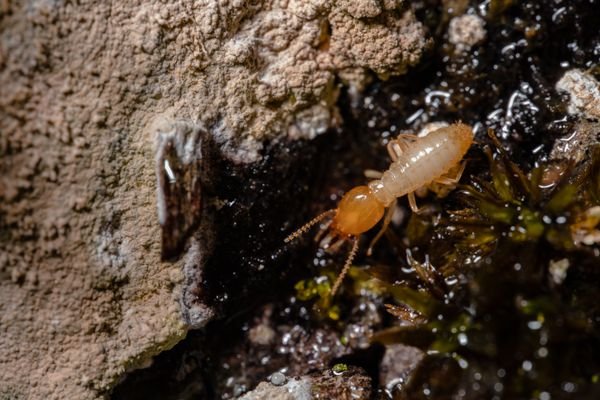
Here's the interesting part: many modern termiticides are non-repellent, meaning they can't detect and avoid it. Instead, they just pick up the substance while moving through treated soil. From there, a transfer effect kicks in — a treated one carries it back to the colony, where others pick it up too. So the effect isn't limited to whichever individual happened to cross the treated zone.
Once it's properly established, a liquid barrier can protect a home for several years before it needs another application. That's the appeal, honestly: get it right once, and mostly forget about it for a good while.
How Bait Stations Actually Work
Bait stations take a different route entirely. Instead of a defensive perimeter, stations get installed in the soil at set intervals around the property, more like feeding stops than a wall. Each one holds a slow-acting substance that they find, feed on, and carry back to share with the rest of the colony.
The goal isn't only to keep them from crossing into your home. It's to work through the colony gradually, aiming to shrink or eliminate it rather than simply redirecting traffic elsewhere. Since this method doesn't rely on trenching or drilling, installation is noticeably less invasive than the underground barrier approach. Nobody's digging along your foundation or cutting into concrete.
What this approach does require is patience and monitoring. Technicians check each station periodically, refresh bait as needed, and track activity over time. It's a slower process, but for plenty of properties, that gradual colony-wide approach is exactly the point.
Side-By-Side: Speed, Installation, And Colony Impact
Put next to each other, these two treatments really do trade off against one another. The barrier method tends to establish protection faster, since it works as an immediate physical and chemical wall the moment it's in place. The other approach takes longer to show results, since it depends on activity finding its way to the stations on its own schedule, not yours. That slower pace, though, often means a more direct hit on colony size, rather than mainly keeping them out. Here's how the two compare, factor by factor:
| Factor | Liquid Barrier | Bait Stations |
|---|---|---|
| How It Works | Termiticide treats the soil around and under the foundation, forming a continuous treated zone | A slow-acting substance is fed on and carried back to share with the colony |
| Installation Method | Trenching, and sometimes drilling, around the foundation perimeter | Stations placed in soil at intervals around the property; no trenching or drilling needed |
| Speed Of Protection | Establishes a protective zone relatively quickly once applied | Takes longer, since it depends on termites finding stations and feeding over time |
| Colony Impact | Can affect the colony beyond the point of contact through the transfer effect | Aims to reduce or eliminate the colony over time, not just block entry |
| Ongoing Monitoring | Reapplication is typically needed after several years | Requires periodic checking and monitoring of each station |
How This Gets Decided For Your Property
So which one fits your house? Honestly, that depends on details specific to your property, not a one-size-fits-all answer. Soil type matters, since some soils hold termiticide differently than others. Foundation type matters too — a slab home and a home with a crawl space present very different installation challenges. And sometimes the smartest call is combining both approaches, pairing immediate coverage with longer-term colony control.

This is exactly why a solid treatment plan starts with an inspection, not a guess. A technician who's actually walked your soil, checked your foundation, and confirmed the activity out there is in a far better position to recommend a liquid barrier, bait stations, or both, than any generic quote sheet could be.
Whichever direction ends up making sense for your home, the goal stays the same: stop the problem before it becomes a structural headache. At EcoFusion, we install and maintain termite bait stations, apply full termite treatment, and build ongoing termite prevention plans so your property stays protected for years, not just one season. And if that's not your only worry, we've got you covered there too — we handle ant control in Short Hills and ant treatments in Livingston, along with the rest of our pest lineup across Northern New Jersey. Whatever's turning up around your property, give us a call, and let's figure out which approach actually makes sense for your home.